


WP4 - Reliability of Urban Flood Defences


Construction technologies and concepts for flood defences and damage mitigation
Cities are complex and vulnerable dynamic systems. They are comprised of assets of high value buildings (i.e. domestic and commercial properties) and complex and interdependent infrastructure networks (i.e. power supplies, communications, water, transport etc.). The infrastructure networks are critical for the continuity of economic activities as well as for the people’s basic living needs. Their availability is also required for fast and effective recovery after flood disasters. The severity of a flood disaster therefore largely depends on the direct impacts of flooding to human beings and their properties as well as on the indirect impacts of flooding such as malfunctioning of urban infrastructure for a certain time period after a flood disaster.
This work package focuses on the development of technologies that better protect these assets against the adverse impacts of flooding and increases the capacity of neighbourhood and cities to recover from flooding.
Three focus areas will be investigated within this work package:
- flood defence networks (improvement of existing defences and multi-functional flood defences),
- flood damage mitigation of critical vulnerable buildings (‘hotspot’ buildings) and shelters and
- lifeline infrastructure.
Task 4.1: Flood Defences

-
Concepts and technologies for multifunctional flood defences
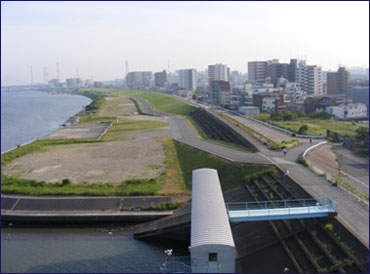
Multifunctional Flood Defences (MFD) is a newly developed concept to optimise allocation of urban space rather than constructing the stand alone dikes. Multifunctional Flood Defences are flood defences that combine the function of flood protection with other functions. In addition to flood protection, multi-functional flood protection fulfill functions like housing, recreation and leisure, commercial buildings, ecology, mobility and transport, underground infrastructure and are a functional part of their urban or rural environment. There are a various forms of multi functionality at the body of a dike or around it to optimise allocation of space.
The focus of the program is to gain a deeper understanding of multifunctional flood defences to provide a foundation for the design, assessment, and management of such defences. Good management practice in developing such a structure consists in maximising the difference between benefits and costs of the project. Therefore, a range of cost and benefit items, that are appropriate for the case of MFD, are introduced for a rather general case. Subsequently, the methodology is partially applied for the feasibility study of two MFD alternatives in the case of Kop van ‘t Land in Dordrecht, two alternatives namely a concrete structure and a soil bank dike are discussed. The preliminary analysis of the two alternatives show that a huge amount of data is needed to conduct in depth cost benefit analysis for each case, whilst they are several questions to be asked as regard to the cost benefit process. The associated costs and benefits are investigated in an integral way to address the practical need for safe and multifunctional solutions and facilitate the integration of disciplinary knowledge.
-
In-situ biotechnical treatment for increased erosion resistance
Internal erosion, among which backward erosion and suffusion, consists of the displacement of soil particles, originating from an embankment or its foundation. Internal erosion can be a threat to levees and dams that are founded on sandy aquifers. In case of flooding, the high head of water can induce piping across a dike, which may finally lead to a breach and inundation of the hinterland.
The BioGrout process is a biotechnological process in which loose sand is turned into sand stone using bacteria. This technology can be a new measure for preventing internal erosion.Small scale tests were performed in the laboratory to to test the employability of BioGrout as a preventive measure against piping. Clay and sand are placed in a container. The clay has a white colour, and the sand a yellow colour and can be recognised by the grain structure.
The container is covered with a glass plate. The water flow goes from left to right. Red dye is added in order to make the water flow visible and the erosion process . -
Video 124: Piping experiment without BioGrout - clay layers on both sides, water flows from left to right
- Video 125: Piping experiment with BioGrout - BioGrout is applied at the location of the dashed line with dimensions: full depth, full width and 2 cm length.
- Video 129: Piping experiment with BioGrout - BioGrout is applied at the location of the dashed line with dimensions: 2 cm depth, full width and 2 cm length.
- Medium scale piping experiment with BioGrout, with dimensions: 4 cm depth, full width and 2 cm length.
The most important conclusion from these tests is a slight increase in strength of the sand over a limited volume is sufficient to prevent piping. It was concluded that BioGrout is a feasible measure for retrofitting structures and mitigating (potential) internal erosion problems. The follow up will be a pilot experiment.
Task 4.2: Damage mitigation for infrastructure and buildings
-
Shelters:
Traditional flood risk management focused on prevention, but a successful management plan must integrate all three levels. Application of flood preparedness strategies reduces the overall impact of the flood event, enhances recovery, and increases the resiliency of the associated region [van Ree et al. 2011]. Lessons from Hurricane Katrina taught emergency planners that preparation of shelters for vulnerable and displaced evacuees must be included in disaster management; displaced populations put stresses on local resources and planning ahead can minimise further damage and the recovery time for the area [Nigg et al. 2006].
Within the project the concept of a “smart shelter” in order to address flood preparedness will be introduced. -
Hotspot buildings are essential nodes in “critical infrastructures”. These infrastructures are of vital importance to the society. Examples of critical infrastructures are technological networks like energy supply, transport services, water supply, information and communication services. Hotspots within these networks are power stations, water treatment plants, control centres of public transport, waste water treatment plants, firefighting stations and hospitals. Failures of hotspots can cause major damage to society and economy: Hence, the need is urgent to identify these “risk hotspots” and develop potential protection technologies.
-
Road Infrastructure
Since the beginning of the project, three stages have been developed, so far. In the first stage, the limits in the application of floating technology for flood-proofing infrastructure in circumstances of flooding and post-flooding were defined. The second stage had consisted in a deep search of floating technology applied to infrastructure state of the art, a first approach analysis of multi-benefits, flexibility/compatibility, traditional/new materials application were also performed. Finally, the third stage had consisting in the development of concepts design of floating technology, applied to infrastructure as a quick response to maintain connection during a flood emergency event and in connection with shelters and hotspot buildings. All three stages have been incorporating the requirements made in connection with the others work packages activities, possible pilot’s necessities and partners/stakeholders suggestions. A specific focus had been established on floating and lightweight bridge research.For the final stages of this research activity, the work to be done consist in: a) the design and elaboration of select concepts, for this purpose, a floating pedestrian bridge will be developing according the necessities of the possible place of application, b) a scale prototype will be fabricate, according to designs defined on previous point, and c). based on the above points make a final report on the integration of technology applied to floating emergency attention by flooding in vulnerable areas; this document will be part of the design guidance text.
Task 4.3: State-of-the-art practices and guidance
-
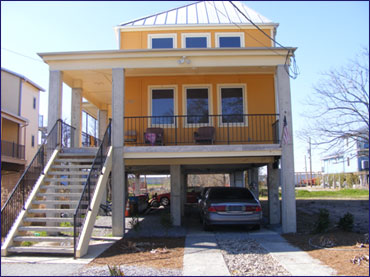
This work package will also deliver a collection and analysis of the state of the art and best practices from across Europe on flood proofing of new buildings and existing buildings (c.q. refurbishments) including the identification of construction materials/practices in place to minimize flood damage.
Finally, a ‘roadmap’ will be developed for property owners and developers in order to provide guidance for resilient building and repair using newer materials and construction techniques. First-hand experience of what approaches are likely to be accepted will be obtained through The National Flood Forum (UK). The National Flood Forum has a large membership which comprises businesses that have been affected by flooding, and have implemented a large range of resilient repairs.